Twisting at your desk, rolling your neck after a long drive, popping your knuckles against the back of a chair: most people have a go-to move for getting that satisfying crack. It feels like relief. But is it actually doing anything helpful, or could it be causing harm?
What Causes the Cracking Sound
The popping sound comes from the small joints in your spine, which are surrounded by fluid that helps them move smoothly. When you twist or stretch a joint past its normal range, tiny gas bubbles in that fluid shift or burst. That’s the sound you hear as cracking. Nothing is actually breaking or snapping into place; it’s a normal, mechanical response to movement.
Is Cracking Your Back Actually Bad for You?
Cracking your back or neck occasionally, as part of normal movement like stretching or twisting, isn’t considered dangerous. The concern is more about how often and how forcefully you’re doing it. Cracking the same joint repeatedly, or using force to make it pop, can gradually stretch the ligaments that hold that joint in place. Over time, a joint that’s been stretched too loose can become less stable.
Frequent cracking can also be a sign that something else is going on, since healthy, well-aligned joints usually don’t demand constant popping to feel normal.
Why You Feel the Urge to Crack
The urge to crack usually comes from a joint that feels stiff or restricted. Cracking it briefly stretches the joint capsule, which can feel like relief for a few minutes. That relief doesn’t last long, though, because the stretch doesn’t fix whatever caused the stiffness in the first place. This is why people who crack their back or neck often find themselves wanting to do it again within an hour or two.
Self-Cracking vs. a Professional Adjustment
If you feel like you need to crack your neck or back several times a day, or the relief barely lasts before the tightness comes right back, that’s worth paying attention to rather than just living with it.
One reason the relief doesn’t last is that self-cracking isn’t very precise. It targets whatever joint feels most restless at the moment, which is often the joint that’s already the most mobile, not the stiff one that actually needs attention. A professional adjustment by a chiropractor works differently: it’s based on a specific assessment of which joint or area is actually misaligned, so the correction addresses the source of the stiffness instead of the joint that happens to be easiest to twist.
How Intouch Chiropractic Can Help
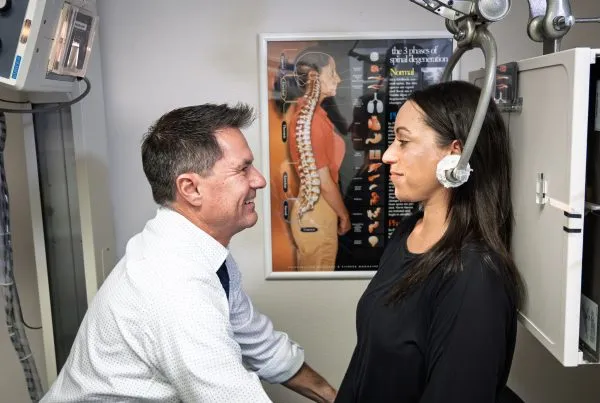
We practice NUCCA chiropractic care, which doesn’t rely on popping or cracking at all. It uses a gentle, precise correction at the top of the spine to restore proper alignment, based on a detailed assessment of your specific misalignment. For people who find themselves cracking their neck or back out of habit, addressing the actual alignment issue behind that urge may reduce how often you feel the need to crack your neck or back in the first place.
Frequently Asked Questions
Is it bad to crack your knuckles too?
Cracking your knuckles works on a similar principle and hasn’t been shown to cause arthritis, despite the common myth. Like back and neck cracking, doing it occasionally isn’t a concern, but relying on it constantly may point to an underlying stiffness worth addressing.
Can cracking your neck cause a stroke?
This is rare, but it’s not impossible. Forceful or high-velocity neck movements, particularly aggressive self-cracking, carry a small risk of affecting blood flow through the neck. Gentle, professional care avoids this risk entirely, since it doesn’t involve the same forceful twisting.
Addressing the Cause
If cracking your back or neck has become something you do several times a day just to feel normal, it may be worth coming into our San Diego office to find out why. Call us today at 619-756-7510 or schedule your consultation online. Our office is located at 2425 Camino Del Rio S #100, San Diego, CA 92108.